
The implementation of the Lymphedema Treatment Act (LTA) has been a major step forward for patients — expanding access to compression garments and improving long-term care outcomes.
But with that progress comes change.
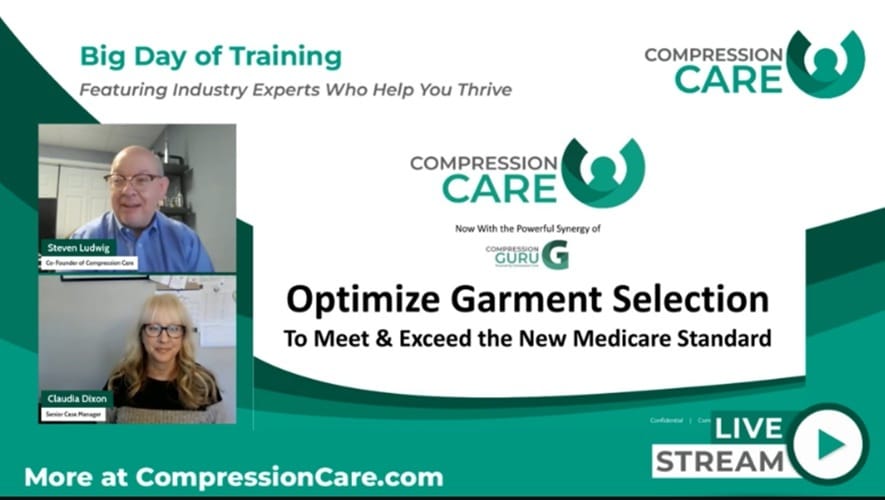
In this Big Day of Training session, Compression Care co-founder Steve Ludwig and Senior Case Manager Claudia Dixon walk through how the new Medicare standard is reshaping:
- Garment selection strategies
- Plan of care documentation
- Use of wraps and accessories
- And even your professional risk as a provider
If you are treating lymphedema patients or prescribing compression therapy, this is essential viewing.
The New Reality: A Defined Medicare Standard
For the first time, Medicare has clearly defined what the at-home maintenance phase should include:
- 3 daytime garments per affected body part (every 6 months)
- 2 nighttime garments per affected body part (every 24 months)
- Accessories as medically necessary
This shift changes more than coverage — it changes expectations.
Providers must now think more strategically about how garments are selected, ordered, and documented.
Best Practices for Ordering Garments
One key takeaway from the session: order smarter, not slower.
For daytime garments:
- Order all three at once
- Reduce delays, duplicate shipping, and administrative burden
- Improve patient experience with faster access
For custom garments:
- Ship one for fit
- Release remaining garments upon approval
For nighttime garments:
- Either order both at once (wash/wear rotation)
- Or space orders based on patient preference
The goal is simple: make the process more efficient while supporting patient compliance.
Where Velcro Wraps Fit In
Velcro wraps have become increasingly popular — especially in cases where:
- Bandaging is not practical
- Patients need easier donning options
- Reduction is still ongoing
By default, Medicare considers wraps as day garments.
However, this session highlights an important strategy:
➡️ When combined with a pad or swell spot, wraps can be counted as night garments
This gives providers more flexibility when building a garment plan — especially early in treatment.
It also reinforces a key theme: there is no one-size-fits-all approach. The best outcomes come from using a mix of tools tailored to the patient.
Documentation Matters More Than Ever
With Medicare audits already underway, documentation has become a critical focus.
Two areas receiving the most scrutiny:
1. Justification for Custom Garments
Providers must clearly document why custom is medically necessary.
2. Justification for Accessories
Items like:
- Silicone bands
- Zippers
- Swell spots
- Skin care products
…must include clinical reasoning, not just patient preference.
To support this, Compression Care has created cheat sheets with sample language based on successful audits — helping providers stay compliant and confident.
A New Consideration: Professional Risk
One of the most important (and often overlooked) insights from this session is how the new standard impacts professional risk.
Now that Medicare has defined a clear baseline, providers are expected to:
➡️ Recommend care that meets or exceeds that standard
For example:
- If Medicare allows 3 daytime garments and 2 nighttime garments
- Recommending less — without justification — could create liability
The key principle:
You recommend the standard. The patient decides what they ultimately use.
This approach protects both:
- The patient’s outcomes
- And your professional responsibility
Supporting Patient Affordability
While recommendations should meet the standard, patient choice still matters.
Compression Care supports this through:
- Benefit verification
- Payment plans
- Lowest out-of-pocket cost guidance
- Alternative purchasing options
This ensures patients can make informed decisions without compromising care recommendations.
Why This Replay Matters
This session is not just about compliance — it’s about delivering better care in a changing environment.
You’ll walk away with:
- Clear garment ordering strategies
- Better understanding of Medicare expectations
- Practical documentation guidance
- Tools to reduce risk and improve patient outcomes
Watch the Replay
Stay compliant. Stay confident. Deliver better care.
👉 Watch the full session replay:
https://www.youtube.com/watch?v=yCMNEbnYEow