
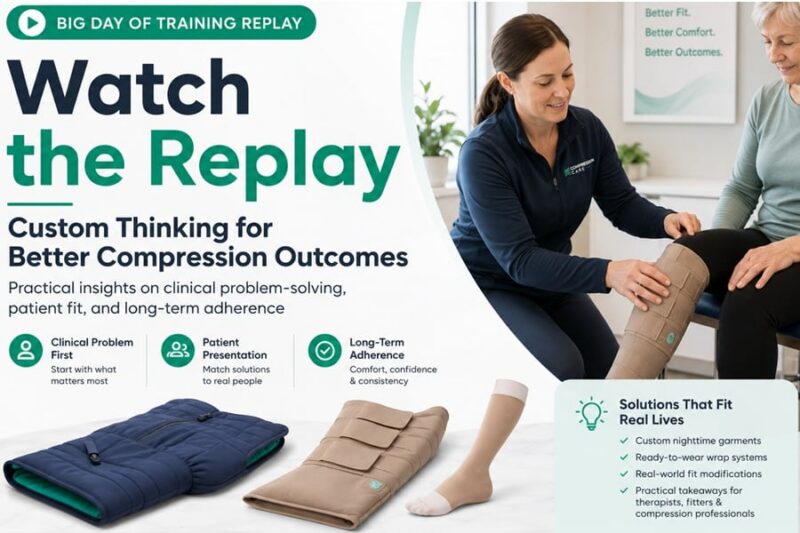
At Compression Care, we know that successful compression therapy is rarely about finding a one-size-fits-all product.
It is about understanding the patient in front of you, identifying the real clinical and practical barriers, and then building a solution that works.
That is exactly what this Big Day of Training session with L&R USA focuses on.
In this replay, Paul Stravone and Randy from L&R walk through how they think about compression products differently — not just by category, but by clinical problem, patient presentation, and long-term adherence. From custom nighttime garments to ready-to-wear wrap systems to real-world fit modifications, this session is full of practical insights for therapists, fitters, and compression professionals.
If you work with patients who need more than an off-the-shelf answer, this is a replay worth watching.
A Different Way to Think About Product Selection
One of the strongest messages in this presentation is simple:
When you run into a clinical roadblock, ask the question.
Instead of thinking only in terms of product categories, Randy encourages clinicians to think in terms of clinical problems:
- Fragile or friable skin
- Sensitive skin
- Fibrosis
- Lobules
- Pannus
- Head and neck swelling
- Difficulty donning
- Balance issues
- Arthritis
- Appliance accommodations
- Compliance concerns
Sometimes there is not a product solution. But sometimes there is — and the value of working with an experienced rep or design center is that they may already know what has worked in a similar situation before.
That mindset runs through the entire presentation.
From Active Treatment to Lifelong Maintenance
L&R Solaris offers products that support the full continuum of care:
- Intensive phase
- Active treatment
- Maintenance phase
- Lifelong management
That matters because the best garment decisions are often made when clinicians start thinking early about where the patient is headed — not just what they need today, but what they will realistically tolerate and use over time.
TributeNight: Custom Nighttime Compression with Real Flexibility
L&R is widely known for TributeNight, and this session does a great job explaining why.
Randy describes TributeNight not just as a product, but as a platform for customization. The presentation highlights how L&R’s design center can create highly specific garments based on:
- Anatomical region
- Tissue presentation
- Fibrosis level
- Donning ability
- Patient lifestyle
- Personal goals
Examples discussed include:
- Shorts with customized features
- Pannus garments that provide both lift and compression
- Head and neck garments with focused adjustable compression
- Torso garments with zippers and adjustable panels
- Garments with custom loops, snaps, zippers, digit spacers, and non-skid elements
A major takeaway is that the answer is often not “can we do it?” but “how do we do it?”
Why the L&R Design Center Matters
A recurring theme in the session is the value of L&R’s custom design center.
According to Randy, the team there has seen nearly everything. That level of experience matters when a patient presents with something more complex — or when a therapist is trying to solve a problem that does not fit into a standard product box.
It also matters because L&R backs those garments with a strong support process, including:
- A one-year warranty
- Repairs when needed
- Adjustments and redesign support
- A 45-day fit guarantee
- Ongoing work until the patient has something functional
That kind of commitment can make custom garments feel far less intimidating for both therapists and patients.
TributeNight SoftFill: A Lower-Profile Option for Comfort
Another key topic is TributeNight SoftFill, a newer nighttime option designed for patients who need nighttime compression but struggle with the bulk or feel of more traditional chop-foam garments.
Randy explains that SoftFill:
- Uses a softer polyester fill
- Feels cooler and more comfortable
- Is easier to don
- Provides a micro-massage effect through the skin-facing material
- Works especially well when comfort and wearability are major concerns
The session makes an important distinction here:
If fibrosis is the main concern, a chop-foam garment may still be the better choice.
If comfort and compliance are the bigger issues, SoftFill may be the stronger option.
That kind of clinical decision-making guidance makes the replay especially helpful.
Tribute Freedom: A New Daytime Option
The replay also introduces Tribute Freedom, a newer custom daytime compression option.
Randy positions Tribute Freedom as a garment that carries the spirit of TributeNight into the daytime space, but with a different purpose. It is designed to be:
- Easier to don than many traditional custom flat-knit garments
- More comfortable for patients who feel claustrophobic in flat knit
- Low-profile and sleek
- Especially useful in vest, bra, pant, and capri applications
This section is particularly helpful for clinicians managing patients who need compression but have historically struggled with daytime compliance.
ReadyWrap and TributeWrap: Ready-to-Wear Options Informed by Custom Experience
The session also highlights how L&R has used years of custom garment experience to develop more effective ready-to-wear products.
Randy discusses:
- ReadyWrap
- TributeWrap
- Ready-to-wear head and neck options
- Bra options
- Full-leg options designed to better navigate coverage realities
A key point here is that these products were not designed in isolation. They were built using what the team learned from years of seeing what actually works for patients in the custom space.
Real-World Support Still Matters
One of the most practical points in the presentation is that L&R wants clinicians to reach out.
If you want:
- A clinic sample
- A free trial
- Help thinking through a difficult presentation
- Support with a custom design
- A conversation about fit or features
They want to help.
That level of accessibility is something Joshua Perkins also reinforces during the Q&A, noting how closely Compression Care works with manufacturer partners to simplify returns, remakes, and exchanges.
Compression Care’s Role in Making It Easier
Joshua adds useful context during the discussion around:
- Remakes and exchanges
- Billing accessories
- Handling Medicaid and insurance limitations
- Care coordination
- Compression Guru self-pay options
- Hardship and payment support
One especially helpful note: Compression Care is actively working to make the return/exchange process easier inside the portal, including a more streamlined workflow for submitting measurements and remake requests.
The goal is the same one repeated throughout the day:
Make it easier for therapists to get the right garment for the right patient.
Why You Should Watch the Replay
This session is especially valuable if you:
- Treat patients with fibrosis or challenging anatomy
- Work with head and neck or trunk edema
- Need more flexible nighttime options
- Want to understand when custom is worth pursuing
- Have patients who struggle with comfort or donning
- Need a better understanding of what L&R can actually build
It is practical, creative, and rooted in real-world problem solving.
Watch the Replay
If you want a better framework for thinking through custom compression, product modifications, and patient-centered garment selection, this is a replay worth your time.
Watch the replay here:
https://youtu.be/Sshwl8t6PZI