If you’ve been in lymphedema or edema management for any amount of time, you already know this truth:
Swelling doesn’t clock out at night.
And yet, nighttime compression is still one of the most misunderstood—and underutilized—parts of the care continuum.
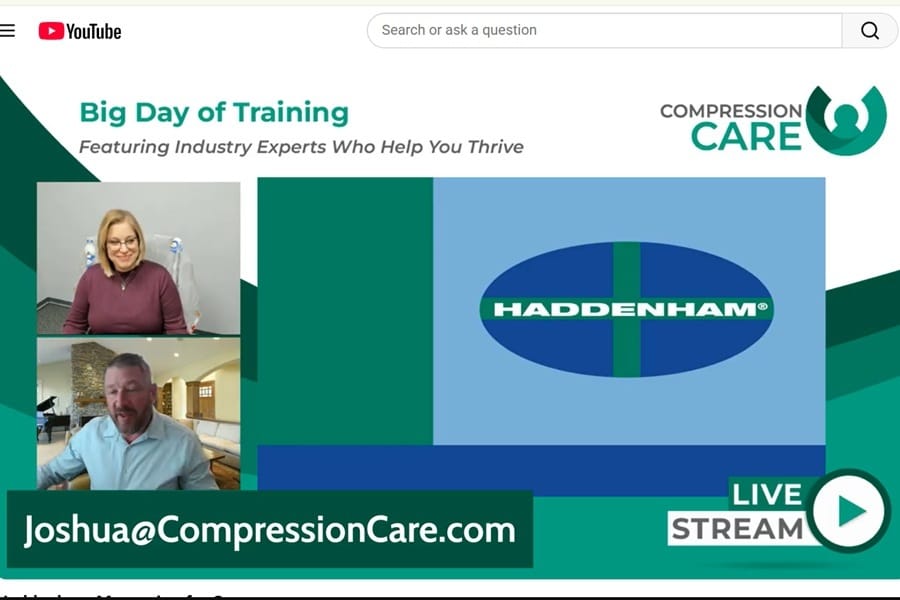
In a recent Compression Care training, Andrea Roloson (former Operations Manager at Haddenham, now with Compression Care) walked through exactly where nighttime garments fit, what makes them effective, and how clinicians can confidently measure, fit, and use them in practice.
Let’s break down the key takeaways.
A Patient-First Approach to Compression
Haddenham’s philosophy is simple:
Give clinicians tools that solve real problems.
That shows up clearly in their Comfy Wave garment—a nighttime compression solution designed specifically for:
- Lymphedema
- Chronic edema
- Wound care support
Unlike traditional daytime garments, Comfy Wave is built for comfort, compliance, and consistency overnight—when patients are most likely to abandon therapy if it’s uncomfortable.
What Makes Comfy Wave Different
This isn’t just “softer compression.”
It’s engineered differently:
- Class 1 compression (15–21 mmHg) → gentle but effective for nighttime use
- High-elastic knit → easier donning and doffing (a big deal for patient compliance)
- Soft, undyed cotton → breathable and hypoallergenic
- Seamless construction → reduces friction and pressure points
- Built-in ridges & channels → mimic chip foam without the bulk
Translation:
Patients get containment + comfort, not one at the expense of the other.
Key Clinical Insight: Measuring Isn’t “One Rule Fits All”
One of the most valuable parts of the training?
Understanding when to follow the rules—and when to break them.
General Rule
- Use tension when measuring
- Size down if the patient is on the cusp
But here’s the nuance:
? Size DOWN when:
- Tissue is soft
- Pitting is present
- You expect volume reduction
? Stay TRUE TO SIZE when:
- Tissue is firm
- Minimal reduction is expected
Important Exceptions (Where Clinicians Need to Slow Down)
1. Breast Band
- Measure over a well-fitted bra
- Do NOT use tension
- Prioritize the over-breast measurement for proper cup support
? Bottom line:
This is about structure and support, not just compression.
2. Neck Garment
- No tension during measuring
- Keep head neutral (no tilt, no rotation)
- Consider:
- Sensitivity
- Skin condition
- Expected fluid movement
? Even a 2 cm difference can completely change the fit.
Real-World Results Matter
In the session, Andrea shared something we see often in practice:
Noticeable tissue changes in as little as one hour.
That’s not just about compression—it’s about:
- Proper fit
- Consistent wear
- The right product for the right phase of care
Pro Tips for Combining Therapies
Comfy Wave isn’t just standalone—it plays well with others.
If layering under Velcro wraps:
➡️ Add +3 cm to wrap measurements
If layering Comfy Wave with Comfy Wave:
➡️ No adjustment needed
If overlapping sleeve + glove:
➡️ Consider sizing shorter, not longer
What About Patient Comfort?
This is where compliance is won or lost.
Feedback from clinicians and patients:
- “I actually sleep in it.”
- “It’s the first garment I didn’t kick off overnight.”
- “Comfortable enough to stick with.”
Is it perfect for every patient? No.
But compared to traditional options, it’s one of the easiest garments to don and tolerate.
Why This Matters for Your Practice
Nighttime compression isn’t just an add-on.
It’s often the difference between:
- Plateau vs. progress
- Compliance vs. abandonment
- Short-term results vs. long-term outcomes
And as Andrea put it best:
“We’re here to help you assess case by case—because that’s what this really is.”
Final Thought
There are easier industries to be in.
But this one? It’s about impact.
And when the right product meets the right patient at the right time—
that’s when you see real change.
See the replay at: https://www.youtube.com/watch?v=EylqDhGuMfk